

Below you’ll find the projects that we’re complete for the section of GHS 210 that was taught by Ania Spyra.


-
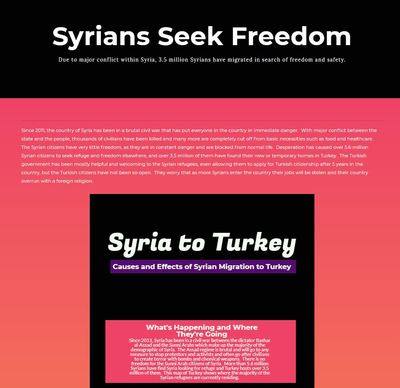
Syrian Refugee Crisis
Jonathan Daniel, Nora Byrne, Ty Brown, and Paige Green
This project examines the migration of Syrians to Turkey during the Syrian civil war.
-

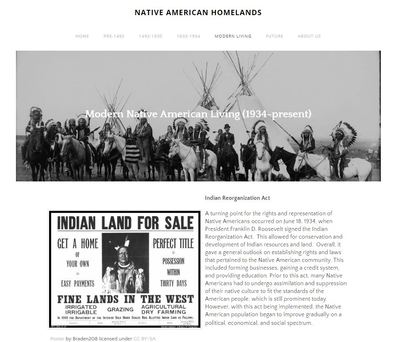
Native American Homelands
Austin Jacks, Kurt Helmich, Royal Hartwig, and Anu Kadampelil
This project explores how the freedoms and homelands of Native Americans have been affected over time.
-
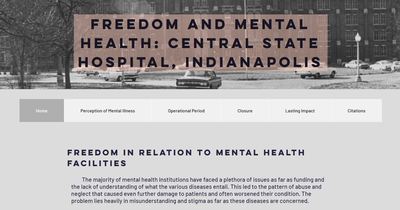
Freedom and Mental Health: Central State Hospital, Indianapolis
Makayla Melton, Shelby Skaggs, Karina Latsko, and Tyler Kryszyn
This project examines how the relationship of purely benevolent and hopeful intentions conflicted with a lack of funding, lack of understanding, and eventually gross abuse and neglect.
-

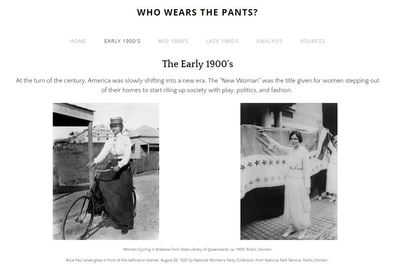
Who Wears the Pants?
Emma Stockrahm, Jessie Surridge, Anna Swenson, and Olivia Stewart
By analyzing prominent historical events, women's clothing, and scholarly writings from the twentieth century and today, this project aims to better understand women's freedoms in America over time, specifically for middle to upper class caucasian women.
-
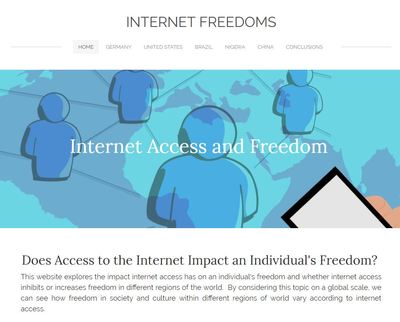
Internet Freedoms
Laura Wilson, Mercedes Vasquez, Gavin Zawacki, and Kassi Tiedjens
This project explores the impact internet access has on an individual's freedom and whether internet access inhibits or increases freedom in different regions of the world.
-
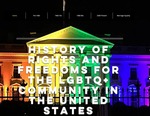
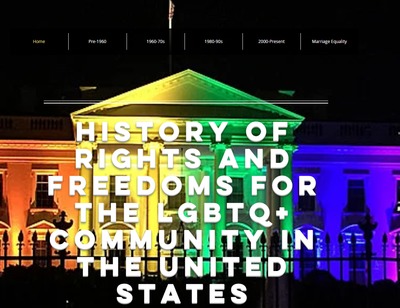
History of Rights and Freedoms for LGBTQ+ Community in the United States
Camille Arnett, Jude Phillips, Kara Stark, and Ted Wenzel
Our mission in creating the website is to illustrate the history and plight of LGBTQ+ people in the United States of America from the beginning of the 20th century into the modern day. Considering the themes of freedom and movement addressed in our class, we found it important to address the victories and losses in the ongoing struggle for social and legal equality for the LGBTQ+ community.
-
The Liberation and Oppression of World War II America
Jarod Deckard, Crystal Fountain, Stephen Gaa, and Courtney Irwin
The United States framed their involvement in WWII as a way to liberate those being targeted and killed by the Nazi regime. However, while fighting for the liberation of those abroad, the United States was forced to face that the practices and attitudes within their own country were not so different than the ones they were working to defeat. The employment of internment camps as a way to isolate Japanese Americans and the pervasive segregation accompanied by the enforcement of Jim Crow laws shed light on the oppression in America. The discrepancy between American ideals and policy with the action of governmental bodies and American citizens highlights the hypocrisy that defined the WWII era and led to the beginning of the Civil Rights movement.
-
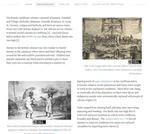
Abolition & Freedom in the British Caribbean
Zach Tran, Maggie Brodbeck, Rhea King, and Madeline Miller
Our website examines the history leading up to and surrounding the abolition of slavery in the British West Indies and the limitations on freedoms for emancipated Africans. The main question of our course is “What is freedom?” and we felt that this topic would be a good way to explore this question’s complexities. We hope that this website will help people to have a better understanding of what slavery was like before emancipation and how the concept of freedom was understood for enslaved Africans living in the British Caribbean at this time. This topic is important because it highlights the obstacles freed African people had to overcome to achieve freedom in the New World.
-
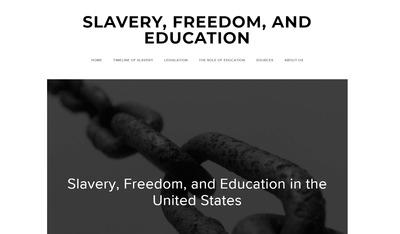
Slavery, Freedom, and Education
Tyler Wagner, Cydney Epp, Billy Collins, and Michaela Althoff
By analyzing historical documents, such as slave narratives and laws pertaining to the education of slaves, engaging with contemporary criticism, and positioning this topic within the conceptual framework of GHS 210-01: Freedom and Movement in the Transatlantic World —that is, considering the relationship between the education of enslaved individuals, freedom, and mobility in the antebellum United States—this project attempts to deconstruct and reorient conventional conceptions of the relationship between slavery, education and freedom. Although education is often viewed as a means of gaining increased freedom and mobility, this project argues that in the antebellum United States both the refusal to educate slaves and the selective education of slaves were used as additional apparatuses of oppression.
-
Housing Segregation in the Indianapolis Area
Kylene Warne, Rachel Efromyson, Ryan Konop, and Grant Conklin
Although segregation is no longer a legal practice, the United States, and specifically Indianapolis, IN, still suffers from the lasting effects of decades of institutionalized, racist practices. These practices can be seen through the study of housing segregation and the motives behind it, redlining conducted within the Indianapolis area, and the still-segregated neighborhoods of this area today. The limits these policies place on the freedom of movement of people of color are a shameful part of our history. By restricting where people of color can live, pursue education and employment, and move their families, the "land of the free" has shown incredible hypocrisy. Our project works to synthesize the information of the past and the present to show the lack of effective policies that have been implemented in attempts to integrate the community. Housing segregation in America is an incredibly stubborn pattern with a complex history requiring complex solutions, and Indianapolis. Segregation in schooling districts, public housing projects, transportation contracts, and persistent stereotypes are all manifestations of, and contributors to housing segregation. We don't claim to detail all of the roots and causes of housing segregation, or to have all the answers. Still, we'd like to present an honest and transparent look at just some of the factors of, consequences of, and potential solutions to the housing segregation in Indianapolis, Indiana.
-

Freedom and the Second Amendment
Laura White, Kelsey Koellner, Nathan Austing, and Drew Herrman
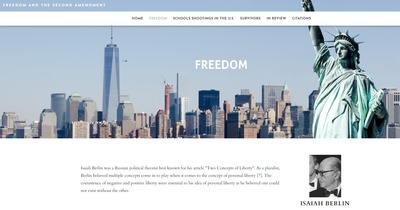
School shootings are an ongoing problem in America as more happen every year that surpass those of the past in death tolls and advancing weaponry. Our multimedia project seeks to discuss the philosophical contrast between freedom to bear arms and safety, as they relate to Isaiah Berlin’s concepts of positive and negative liberty. We especially concentrated on school shootings, namely the Marjory Stoneman Douglas shooting (2018) which is one of the largest school shootings to date. Our goal is to explore these concepts and argue that there need to be stricter gun laws so that U.S. citizens can have both the freedom to bear arms and the freedom from gun violence.